-
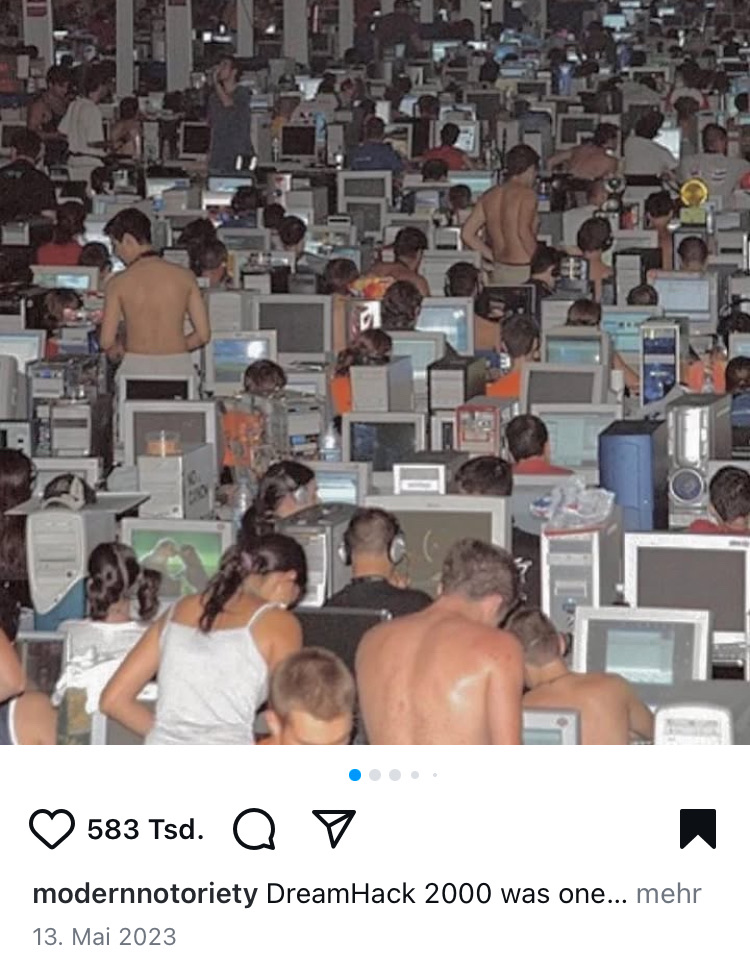
dreamhack 2000
-
Democracy, Neo-Orality, and the Unraveling of Political Norms
Neo-orality is not a Western anomaly—it is a transcultural media condition rooted in platform infrastructures, affective economies, and the post-print collapse of epistemic gatekeeping. While its emotional tones vary—nationalist vengeance in the U.S., spiritualized resilience in India—the underlying communicative logic is strikingly consistent. This is not about culture; it is about infrastructure. The affective, real-time, and highly performative logic of neo-orality flourishes across contexts because it is amplified and shaped by global platforms that reward virality over coherence, resonance over reason. Publics increasingly form not through deliberation but through “affective attunement” (Papacharissi, 2025)—a shared sensibility sustained through images, gestures, and digital proximity. In this sense, neo-orality is not merely a return to earlier oral traditions, but a global mutation of political discourse—digitally mediated, epistemically unstable, and profoundly shaped by the emotional architectures of our time.
Neo-orality’s political implications are profound: it collapses the distance between spectacle and truth, compresses deliberation into performance, and replaces the ethos of persuasion with the affective pull of belonging. This is not just a new media form—it is a new condition of knowing.
The consequences for democratic discourse are profound. Politicians succeed not by persuading across lines of difference, but by performing loyalty to a tribe. Rational debate gives way to memetic warfare. Argument becomes vibe.
– Jacqueline Fendt
Read more -
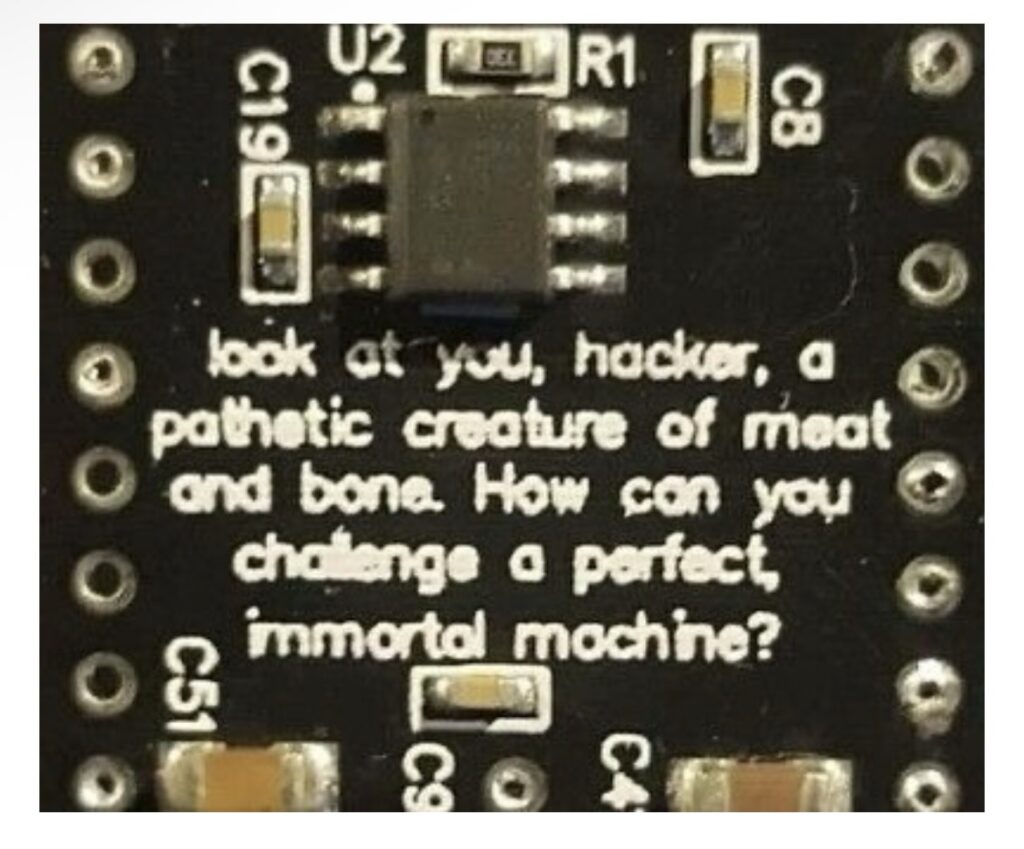
Creature of meat and bone
-
Digital Tarkovsky
“Your phone screen is broken several times over. But it doesn’t
matter. You look up. You are walking along the deserted train
tracks, in between the high grass. No matter how hard you try,
you can’t shake the feeling that you’ve been here before. If not
personally, then certainly in some shared memory. You
remember a discussion that took place in school. Someone said
that the world has run out of places, that it has run out of
unknown. Someone else did not agree. Reality is always a
mystery, everyday, he said. But the other one continued: having
run out of unknown on this planet, you jump off the edge of a cliff
with a GoPro Hero camera attached to your wrist.
On the cliffedge of this utterly mapped world, this is what you do. You think it
is about the only thing you can still do. This is like jumping off a
flat planet, the medieval planet. You’ve run out of ideas on how to
conceive of its spheric shape as an astral body, an alien planet,
and of yourself, and others, as utter strangers, as aliens, so in a
way there’s nothing there for you anymore, there’s just this flat
world. You jump. Off the edge, into the undefined. But the belt
catches you.”
– Metahaven
read the book -
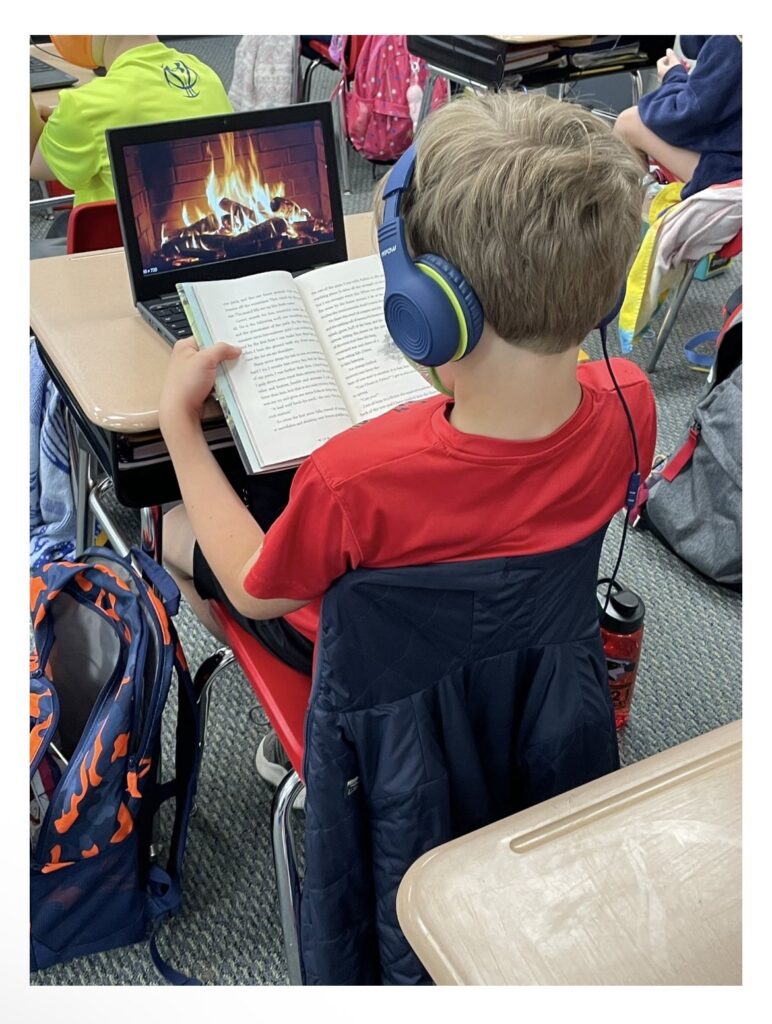
Reading routine
-
The Medium is the Massage
“Societies have always been shaped more by the nature of the media by which men communicate than by the content of the communication. The alphabet, for instance, is a technology that is absorbed by the very young child in a completely unconscious manner, by osmosis so to speak. Words and the meaning of words predispose the child to think and act automatically in certain ways. The alphabet and print technology fostered and encouraged a fragmenting process, a process of specialism and of detachment. Electric technology fosters and encourages unification and involvement. It is impossible to understand social and cultural changes without a knowledge of the workings of media.”
– Marshal Mcluhan
read the book -
Nighttime routine
-
Technofeudalism

Screenshot read the whole book
or read more Yanis Varoufakis -
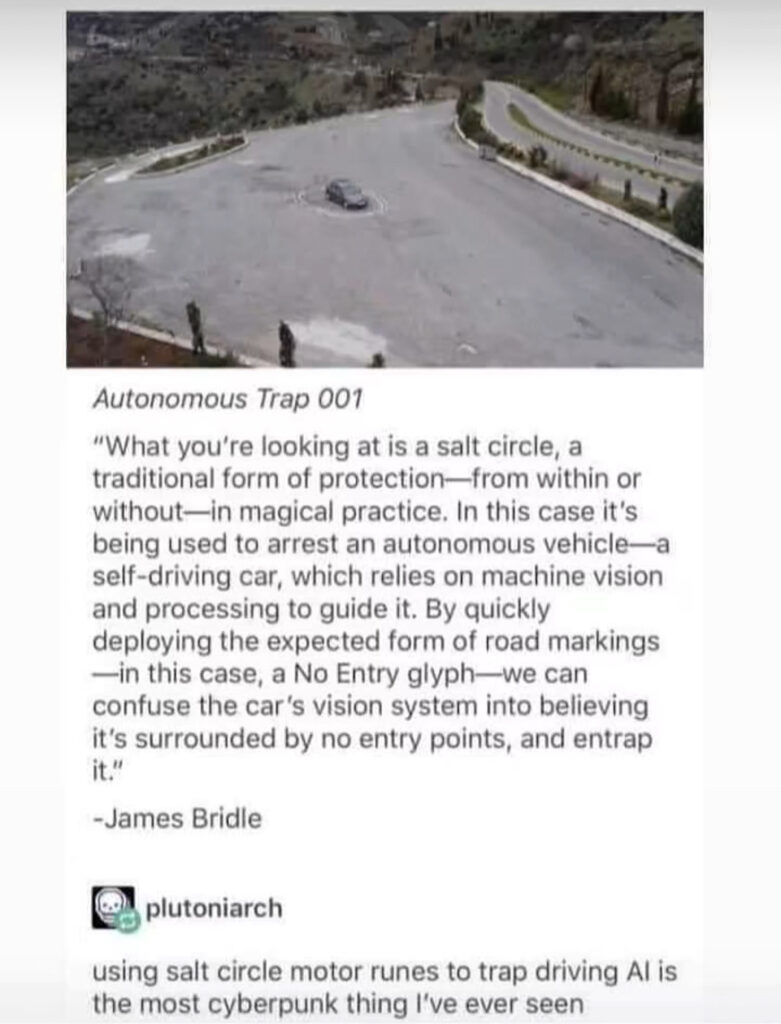
Autonomous Trap 001
-
AI, Mind Control, and Magic
We can think of magic as a type of media. One that operates in the world of preconscious perception, playing with associations, expectations, symbols, and other forms of media to alter perception, to influence behavior, to affect the physical world, and to produce any number of other effects. To study magic is to study the quirks, foibles, and everyday hallucinations that characterize human perception, and to use those gaps between reality-as-it-is and reality-as-it-is-perceived as a vehicle for making supernatural-seeming interventions into perceived reality.
– Trevor Paglen
read more -
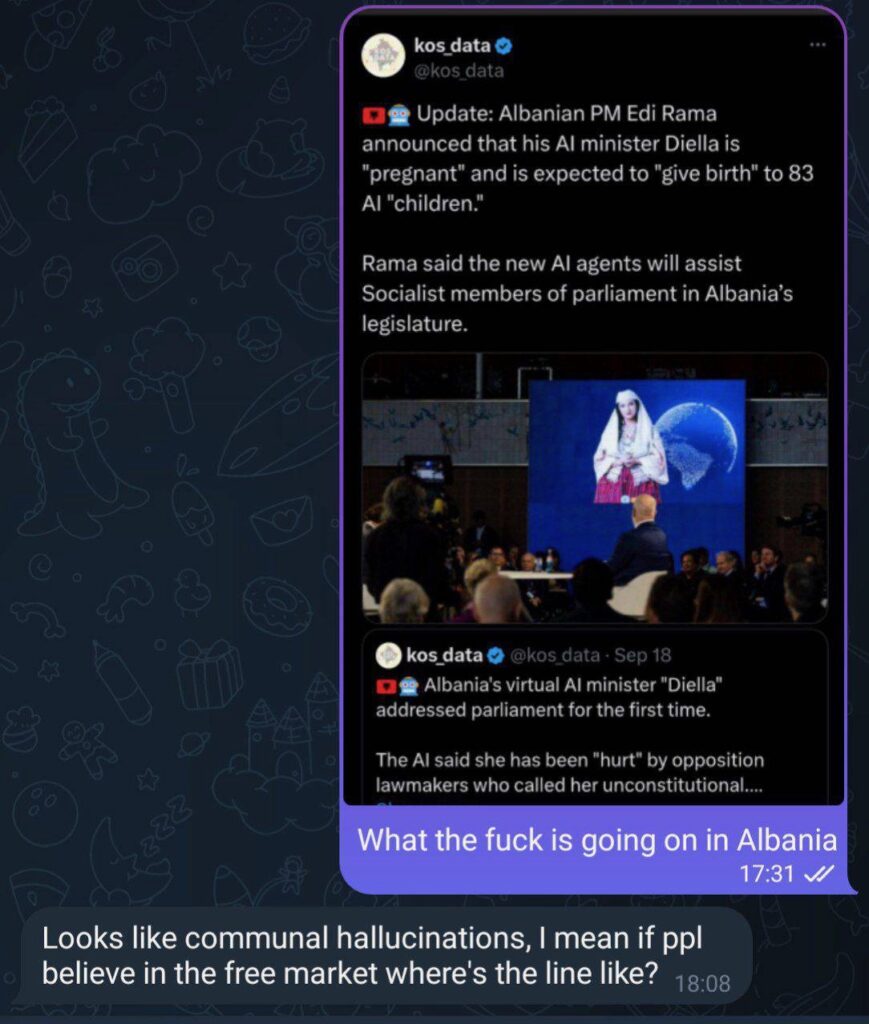
What the fuck, albania…
-
DIGITAL FOLKLORE AND CYBER WITCHCRAFT
The re-enchantment of technology confirms that technology is not inherently opposed to spirituality and that it is, to a certain extent, inevitable—while we may limit screen time or vow never to be iPad parents, the rage of digitalism is everywhere, and the values and aesthetics of the cyber world consolidate them, challenging existing orders in our physical and liminal worlds. In the magical world of cyber witches and folklorists, we find an intriguing compromise: if technology or God cannot be destroyed, they must be integrated, becoming part of contemporary fixation, folklore, tradition, and practice.
– Isabella Greenwood
read more -
relationship to technology
-
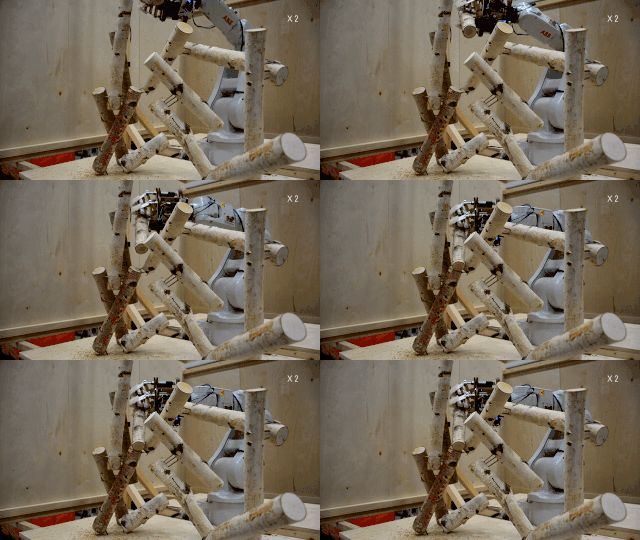
The Architect as Magician
Magical skills originated as an attempt to make order out of chaos, as early humans attempted to ration- alize a confusing and seemingly indefinable universe. This notion, namely that to define the elusive effects of how we, as humans, inhabit the world, remains a large part of our search for meaning. This discussion argues that architecture and magic function in a similar manner. When architecture offers more than mere shelter, we recognize that it, like magic, can also participate in the search for defining and representing the cosmos. In effect, such a search may have emerged from humans’ desire to materialize the immaterial and is not unlike the initial stages of architectural design, or any creative process.
– Albert C. Smith and Kendra Schank Smith
read the book -
Architecture’s contribution to the digital sphere…
-
queer in the straight

-
Is access now a form of intimacy?
“But this new architecture of closeness invites critique.
Silence no longer means absence. But it also no longer means presence. Delay doesn’t necessarily signal indifference. But it doesn’t confirm care either.
We are left inside a mode of intimacy that is difficult to read, easy to misinterpret, and quietly exhausting in its ambiguity. It comforts and unsettles in equal measure. There is safety in not demanding too much of each other but also a subtle erosion of clarity, a thinning of emotional texture.
We learn to “hold people without interrupting them,” to let relationships remain open, suspended, unfinished. This feels contemporary, yes- but also precarious.
“What remains isn’t interaction, but a sustained awareness.”
Almost like an emotional diagnosis of the digital age.
Which leaves us, collectively, with a necessary question:
If intimacy is now measured by the possibility of reaching rather than the act itself, how do we distinguish closeness from coincidence, connection from interruption, presence from its perfectly rendered imitation?“
– studio in grey
read more on substack -
cyborging

-
Never met a science (blog)
“We’ve past peak social media; everything is becoming slop, gambling, addiction. The open web is increasingly a dead internet, inhabited by bots or — much worse — humans who have been conditioned into behaving like bots. And that’s just what we can see. The really degrading stuff is happening in the privacy of LLM-backed chat interfaces, where humans can spiral into insanity without even a minimal tether to social reality.
As Flusser anticipates, in Post-History: “what we dread is the inexorable progress of culture. Today, to engage oneself with freedom, and more radically, to engage oneself in the survival of the human species on the face of the Earth, implies strategieas in order to delay progress. This reaction is today the only dignified one.” We can now observe, in the brutal progress towards a meaningless internet, the necessity of Heidegger’s step-back, of the refusal to take things as they are.”
for example:
The Tragedy of Stafford Beer
Towards the Post-Naive Internet
Facebook is Other People
– Kevin Munger
read more on substack -
patenting
-
Limiting Not Just Screen Time, But Screen Space
The internet arrived in my home as a window, an enchanted portal cut into ordinary domestic space. A window is fixed in place. “I’m going online” meant you were heading to a specific place in the house, along the lines of “I’ll be in my room” or “I’m going to the attic.” To peer into the internet, I had to sit in my parents’ maroon computer chair. To my left, through the non-metaphorical window, I could see telephone wires running down the street, carrying away my messages.
I was born into a world that contained telephones just as it contained stones and trees. The internet differed from the telephone in its unvoicedness, but they shared a familiar infrastructure. It was physical and placed. There was a here that somebody had connected with copper wire to a there.
Then came AOL Instant Messenger. It was an awful place for middle schoolers, but there we were anyway, a swarm of screennames in chatrooms, my own (PyRoAnGeL5) among them. Suddenly, school life ran on two channels, what happened at school and what happened at school at home.
Still, you could leave.
You could stand up, walk away from the computer, step back into your body and your house. In fact, you had to. Our digital lives were structured by departures.
– Laura J. Martin
read more -
cv dazzle
-
Gamer Theory
“Ever get the feeling you’re playing some vast and useless game whose goal you don’t know and whose rules you can’t remember?
Ever get the fierce desire to quit, to resign, to forfeit, only to discover there’s no umpire, no referee, no regulator to whom you can announce your capitulation? Ever get the vague dread that while you have no choice but to play the game, you can’t win it, can’t know the score, or who keeps it? Ever suspect that you don’t even know who your real op. ponent might be? Ever get mad over the obvious fact that the dice are loaded, the deck stacked, the table rigged and the fix—in?
Welcome to gamespace. It’s everywhere, this atopian arena, this speculation sport. No pain no gain. No guts no glory. Give it your best shot. There’s no second place.Winner take all.”
-McKenzie Wark
-
Making Sense of TikTok
-
The Wretched of the Screen
“A kiss is an event that is shared and consists
precisely of sharing, exchanging, and happening in
between bodies. It is an edit articulating affect in
ever-different combinations. It creates new junctions and forms between and across bodies, a form
that is ever shifting and changing. A kiss is a moving
surface, a ripple in time-space. Endless reproductions of the same kiss: each one unique.
A kiss is a wager, a territory of risk, a mess.
The idea of reproduction condensed into a fleeting
moment. Let’s think of reproduction as this kiss,
which moves across cuts, from shot to shot, from
frame to frame: linking and juxtaposing. Across
lips and digital devices. It moves by way of editing,
exquisitely flipping around the idea of the cut, redistributing affects and desire, creating bodies joined
by movement, love, pain.“
– Hito Steyerl
read the book -
burn notre dame, burn

-
Mindless NPC
“Another example: Two years ago, a video went viral depicting a streamer named “Pinkydoll” pretending to eat ice cream like a dog. “Mm, ice cream, so good,” she repeats, as she collects coins from her viewers. Her eyes are dead, her skin smooth like a Barbie doll’s. In the wake of the video’s virality, a ream of think pieces emerged explaining that this style of content and performance is a genre called “mindless NPC.” It’s named after the side characters in video games who don’t have consciousness, the idea being to mimic the jerky movements and vague sexuality of a computer simulation.
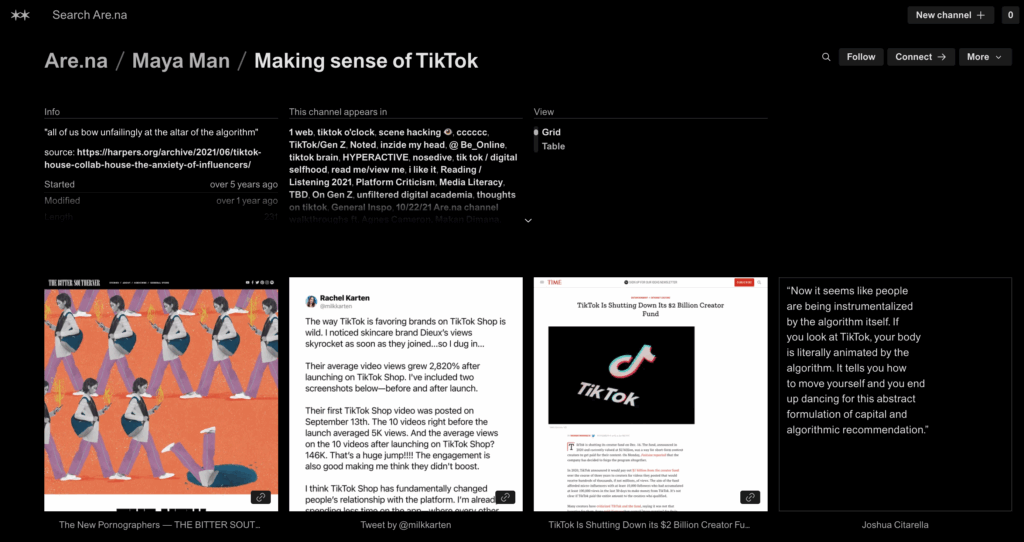
As Joshua Citarella put it on an episode of the New Models podcast, “If you look at TikTok, your body is literally animated by the algorithm—it tells you how to move yourself.” As you follow along, he says, “you end up dancing for this abstract formulation of capital and algorithmic recommendation.“
– Sam Venis
read more -
lazy chat
-
umbrel?
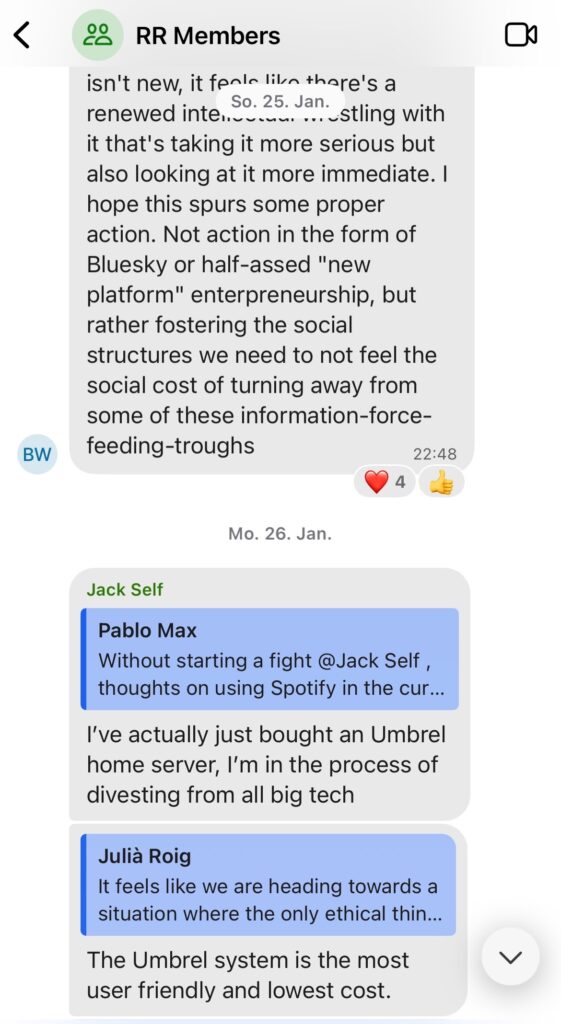
Anyone wants to go umbrel together?
they’re sold here -
A cyborg manifesto
“From one perspective, a cyborg world is about the final imposition of a grid of control on the planet, about the final abstraction embodied in a Star Wars apocalypse waged in the name of defence, about the final appropriation of women’s bodies in a masculinist orgy of war (Sofia,1984). From another perspective, a cyborg world might be about lived social and bodily realities in which people are not afraid of their joint kinship with animals and machines, not afraid of permanently partial identities and contradictory standpoints. The political struggle is to see from both perspectives at once because each reveals both dominations and possibilities unimaginable from the other vantage point. Single vision produces worse illusions than double vision or many-headed monsters. Cyborg unities are monstrous and illegitimate; in our present political circum-stances, we could hardly hope for more potent myths for resistance and recoupling.”
– Donna Harraway
-
Overthrowing our Tech overlords
“For young people in today’s world curating an identity online is not optional, and so their personal lives have become some of the most important work they do. From the moment they take their first steps online, they suffer like Movatar from two perplexingly contradictory demands: They are taught implicitly to see themselves as a brand, yet one that will be judged according to its perceived authenticity. (And that includes potential employers: “No one will offer me a job,” a graduate told me once, “until I have discovered my true self.”)
And so, before posting any image, uploading any video, reviewing any movie, sharing any photograph or message, they must be mindful of who their choice will please or alienate. They must somehow work out which of their potential “true selves” will be found most attractive, continually testing their own opinions against their notion of what the average opinion among online opinion makers might be.”
– Yanis Varoufakis
read more -
Alignment
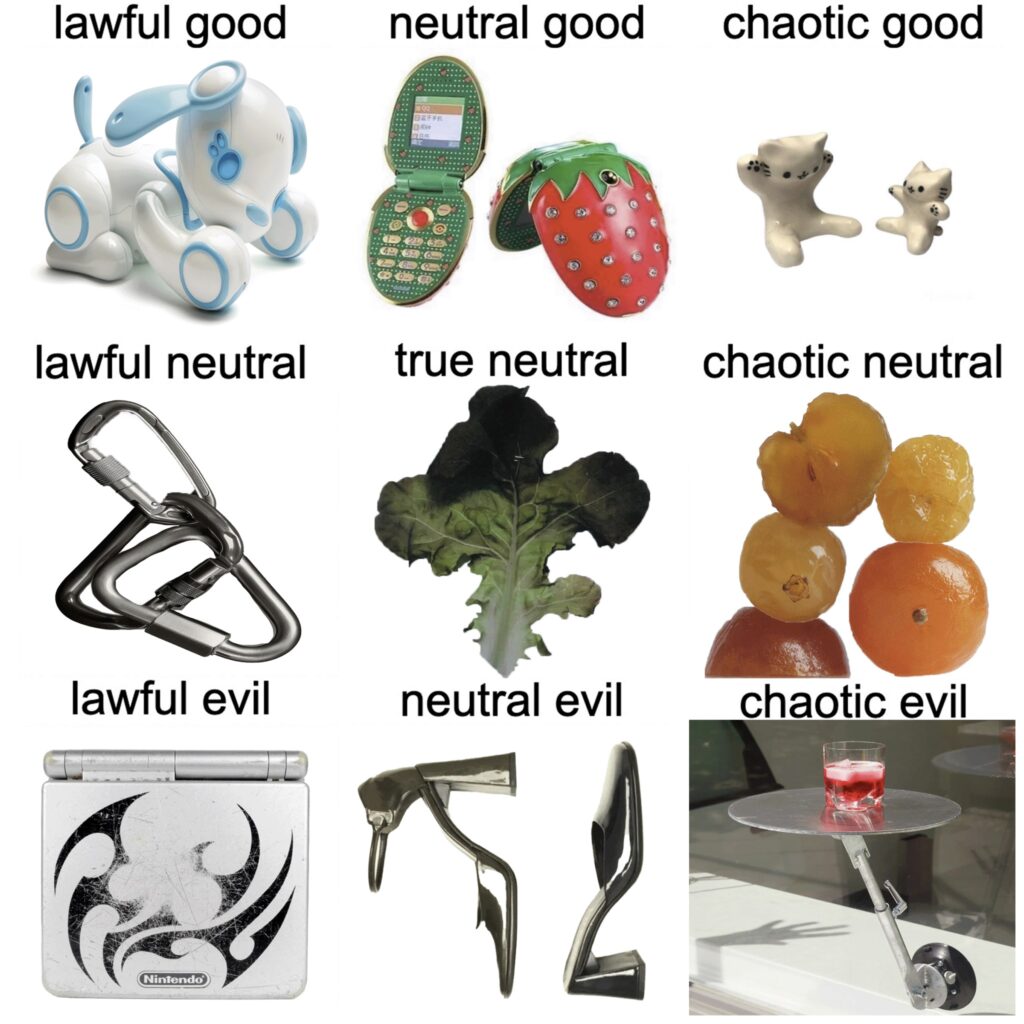
-
Asmr tarot
– ediyasmr
-
The Image of Text
“If you ever felt like ChatGPT sounds like a Redditor, it’s because Reddit, Wikipedia, StackExchange, Quora, and the like, are where crawlers are sent to collect those savory well-punctuated text blocks for training data.
It is unfortunate that this choice to prioritise the boring editorial style over schizoid misspelled ramblings was made for the LLM by some engineers and corporate strategists, but it’s what’s needed for mainstream utility, also known as ‘what’s good for business?.”
– Al Hassan Elwan (aka POSTPOSTPOST)
read more -
Pope embodied
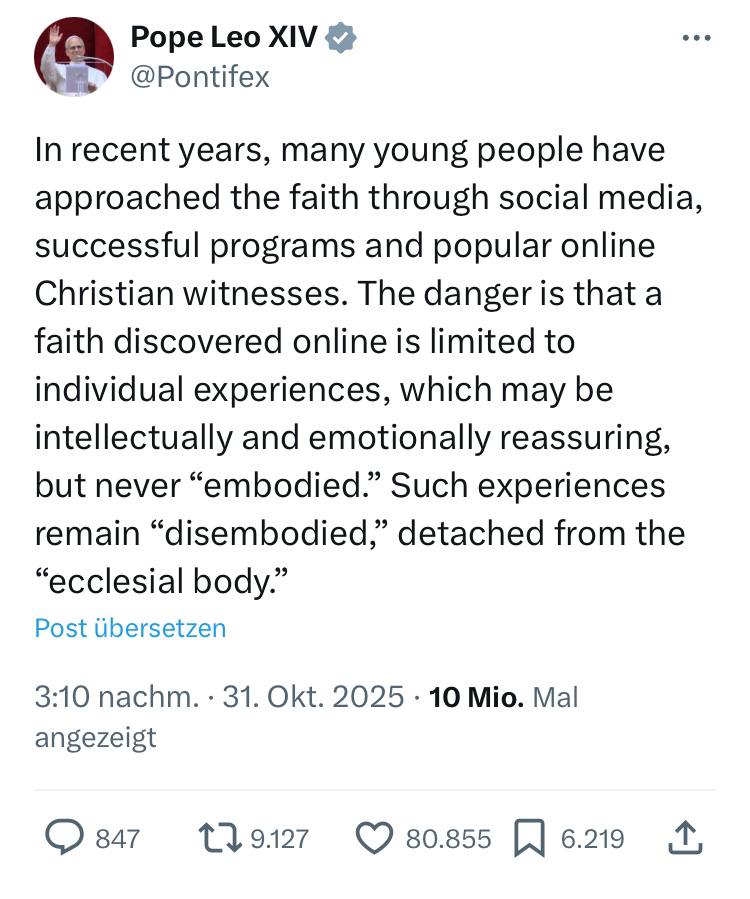
-
Depeche Modem
NM speaks with Kevin Driscoll, author of The Modem World – A Prehistory of Social Media (Yale Univ. Press, 2022), which examines the physical — and social — technology that underpinned the DIY side of networked technology’s evolution in the ‘80s and ‘90s.
Parallel to institutional network culture were the proto-dark-forest communities of BBS networks and other pre-www systems. From FidoNet to De Digitale Stad (DDS) Netherlands, Kevin maps out this early territory, with a brief history of the French Minitel system along the way.
Through his work, Kevin asks us to consider what it really means to be “autonomous” online and what alternate conceptions of “the internet” might be possible when we consider the broader origin story of the digital social sphere.
read more Kevin Driscoll
read more NEW MODELS -
machine

-
Player One and Main Character
“What happened? What changed? I don’t think Musk and Trump were simply radicalized on social media like the average Rust Belt uncle. I think these periods of their lives also accelerated and intensified their descents into fiction, their respective evolutions into living-breathing avatar and character. In those years, both men, already shielded by their immense wealth, already rewarded for decades of bombastic risk-taking in move-fast-break-things Silicon Valley and greed-is-good New York, grew even more uninhibited, impulsive, and brash. It was almost as if they were beginning to feel—and, in some sense, be—free of the fundamental quality that distinguishes reality from fiction: consequence.”
– Gideon Jacobs
read more -
gravestone

-
A eulogy for cyberspace
But servers are machines with fans, hard disks, and a maximum operating temperature. They are furnished with parts and materials sourced so violently, so cruelly, that every server, every router, every phone on Earth likely carries the debris of its own creation. A fragment of a child worker’s severed limb; a fingernail, or a drop of blood. The fur of a terrified creature maimed in the supply chain and machined into the very device you now hold.
So no – cyberspace will never be left alone by the real world, because that is impossible. The servers are material. They are not safe, and they are not good. They’re flooding in the world’s annual once-in-a-lifetime monsoons. They’re on fire in the routine freak Texan and Californian heatwaves. They’re bought and sold by private equity. They are targets for state actors, militaries, teenage hackers, Luddites, and anarchists alike.
When the server goes dark, we go dark, too. We’ve built an entire civilisation on an unthinkably brutal and comically unreliable stack while hallucinating it as literally anything else. We condemn AI today for making shit up, but what about us? We’re building on a fantasy just as brittle, we are just as demonstrably wrong. Yet we pretend a file isn’t just a gesture that can disappear in an instant. We hallucinate that the server is somehow both fleeting and forever.
– Cade Diehm
read more -
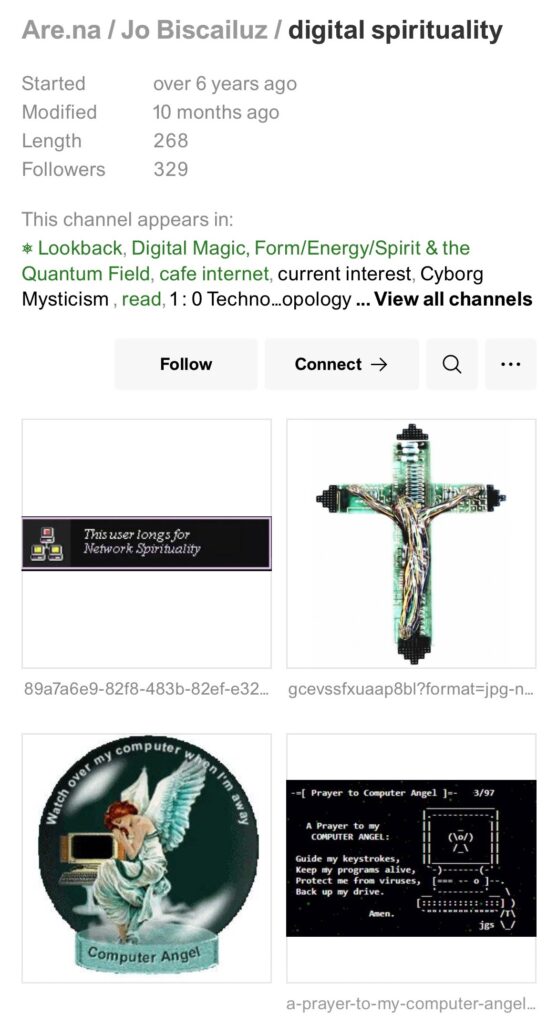
digital spirituality
-
the internet does not exist 2
We are not accustomed to the idea that non-human, inanimate objects possess agency and activity, just as we are not accustomed to the idea that they can carry information unless they are endowed with code/text-based information technologies. While accepting that a technology like mobile telephony has become the world’s largest shared platform for information exchange, we are perhaps less accustomed to the idea of space as a technology or medium of information – undeclared information that is not
parsed as text or code. Indeed, the more ubiquitous code/text-based information devices become, the harder it is to see spatial technologies and networks that are independent of the digital. Few would look at a concrete highway system or an electrical grid and perceive agency in their static arrangement. Agency might only be ascribed to the moving cars or the electrical current. Spaces and urban arrangements are usually treated as collections of objects or volumes, not as actors. Yet the organization itself is active. It is doing something, and changes in the organization constitute information.
– Keller Easterling in The Internet of Things
read the book -
exploring
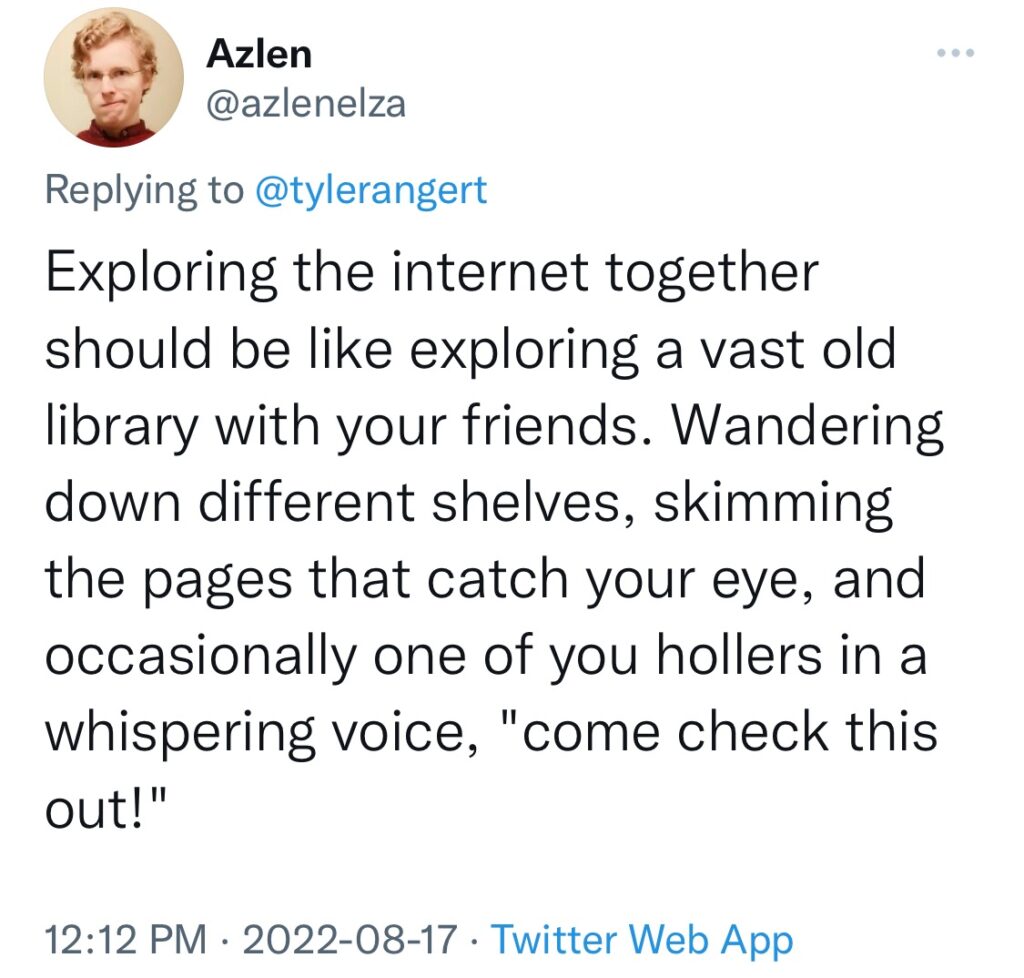
-
new babylon
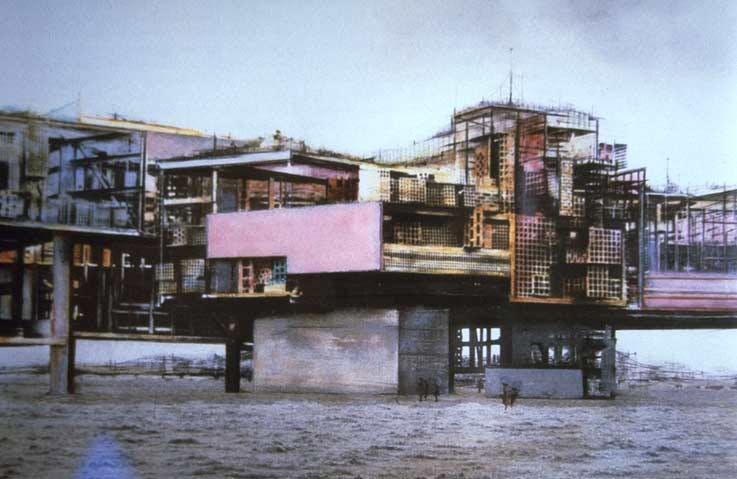
It is obvious that a person free to use his time for the whole of his life, free to go where he wants, when he wants, cannot make the greatest use of his freedom in a world ruled by the clock and the imperative of a fixed abode. As a way of life Homo Ludens will demand, firstly, that he responds to his need for playing, for adventure, for mobility, as well as all the conditions that facilitate the free creation of his own life. Until then, the principle activity of man had been the exploration of his natural surroundings. Homo Ludens himself will seek to transform, to recreate, those surroundings, that world, according to his new needs The exploration and creation of the environment will them happen to coincide because, in creating his domain to explore, Homo Ludens will apply himself to exploring his own creation. Thus we will be present at an uninterrupted process of creation and re-creation, sustained by a generalized creativity that is manifested in all domains of activity.
– Constant Nieuwenhuys
read more -
church
-
gamer theory 2
THE SIM who suffers turns to face its gamer, looking out toward an absent sky, appealing directly, beyond the frame of the game itself. The gamer may not answer, or may not be able to answer. The gamer as God suffers from an apparently similar algorithmic logic as the Sim. The Sims comes with theological options. Turn on “free wil’ and Sims stray from the powers of their maker. Turn it off and their actions are predestined, but even so the gamer-God quickly finds that the algorithm is a higher power than the power one commands. Should the game be going badly for the Sim, it turns to face the gamer; should the game be going badly for the gamer, there is no one for the gamer to turn away and face. The Sim who addresses a helpless, hopeless, or lost God lives out the allegory of gamespace itself. At least the Sim has someone to turn to. Who can the gamer turn to? Perhaps you can see now the reason for the popularity, among those troubled by gamespace but lacking a concept to account for it, of a personal God who can perform miracles, who can break the rules of his own algorithm.
– McKenzie Wark
read the book -
flesh machine devine
-
pope 2

Go down into the underground, and pass from the hyper-virtual, fleshless world to the suffering flesh of the poor. This is the conversion we have to undergo. And if we don’t start there, there will be no conversion.
– Pope Francis -
towards a theory of the dick pic
As I write this paragraph, somewhere in Los Angeles my dreamy little slave is waiting for further instructions. I have something for him. An image I think he will like. I want something in return. It is an image as well. Some forms of exchange in our recent interactions include: emoji, clothes, songs, texts, images, spit. More might be: vulnerability, power, pleasure, pain. There is a foreground and a background in a transaction of digital photos across two iPhones, with equally material realities. On either side of our recurrent (…)s are our bodies, their surroundings, their productions (verbal, emotional, and otherwise), but also the faux palm tree scaffolding broadcasting his cell signal, my neighbor’s modem (how I steal wifi), the fiber optic cables that tunnel beneath the city, connecting our data (how romantic), the government satellites tasked with surveying it, the guarded server farms where it is inevitably stored.
-Tracy Jeanne Rosenthal
read more -
game bible

-
communicology 2
On the level of elite communication texts and technical images complete each other; they aim at each other. Technical images give texts very specific meanings, and they provoke new texts. It is not a question of technical images illustrating texts, and texts describing technical images, as is the case in traditional image-text relations: there is feedback between the two codes that lifts texts to the level of technical imagination. But this works as it does only within the closed circuits of hermetic dialogues in technology and science. On the level of mass communication, apparatus are progressively devouring all the texts in order to be recoded as technical images. This is a case of absorption of conceptual thought by technical image codes to be radiated and to program receivers that have no technical imagination: a case of progressive destruction of conceptual thought, of historical reason, of linear consciousness, and of passive reception of opaque yet effective programs. The result is a progressive strengthening of the apparatus-operator complexes that radiate the programs.
– Vilem Flusser
read the book -
Google docs
-
On the Origin of Species and Other Stories
The measurement of time is relative. It flows more slowly at lower altitudes than at higher ones, and it’s slower for a person running than for one standing still. Time flows subjectively. We’ve all had the experience of
dreaming several hours’ or days’ worth of events during a short nap. Scientists have formulas for translating time differences into velocity or gravity. You can’t really measure time in years or months. Time moves at its slowest during childhood. A year for you is not the same as a year for me. One of your years could be a single day for me. A few of my days could be dozens of years to you. In but a few of my days, therefore, a child can obtain an amount of knowledge and experience that would take me aeons to accumulate. This should be expressed in a mathematical formula, and the formula should be made available in textbooks. After all, people don’t believe anything that isn’t expressed in numbers.
If that were to happen, grown-ups would stop thinking of children’s time as insignificant. If only they realized that you are in fact being forced to sacrifice hundreds of years for the sake of the last few days of your life, the world would be a different place… at least a little bit.
– Bo-Young Kim
Read the book -
data crunching
Screenshot -
the para-real manifesto
Between the digital realm and our physical world is a third space — hybrid, ephemeral and poorly understood. You may have encountered it recently: an uncanny or unreal sense of almost touching something in a VR scene, an impossible fatigue during a Zoom call that leaves you floating like a balloon full of lead, or an eerie unease at the accuracy of a targeted advertisement. For decades, this in-between space has influenced the digitised society unseen. We call it the Para-Real, an emotional and transformative state that emerges when the electronic and the real collide, and — just for a moment — creates a space that can only exist at the exact second where platforms and atoms operate in absolute parallel. The para-real occurs inside this time-space, a form of perception and interface de-realisation whose boundaries can no longer be perceived—and whose affects are longer separated. The para-real is at once conditioned by computational forces, yet also immune to the parasitic intrusion of practices of extraction. The para-real is thus a paradoxical state of subsistence within the fissures of the digital and the analogue. The para-real is what occurs before the cybernetic digestion.
– Cade Diehm
read more -
you choose
Screenshot -
neocities
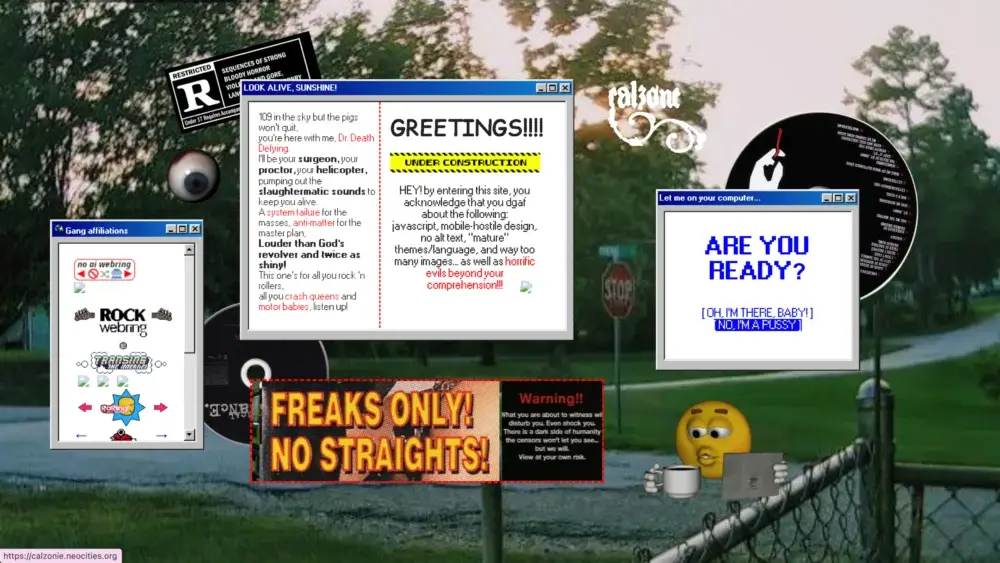
Neocities seems incredibly important in a moment where human art is being overshadowed. Users like RHFZ recognise the importance of its permissive censorship policy and lack of invasive “algorithming”, which they point out leads to fewer trolls. “You can’t gamify the platform by provoking others. ‘Rage-baiting’ doesn’t lead to a big public payoff.” RHFZ did float their concerns over public vilification of uncensored web hosting and its capacity to accommodate radical/extremist material in the wrong hands, though moving through Neocities today, that scenario feels pretty far off.Browsing Neocities feels as close to the wholesome notion of ‘surfing the web’. Exploration is addictive and the idea that artists can freely host their own galleries and visually curate their personalities seems far more utopian than the offline art world. Part of the formula is that no one is there to tell you that you’re breaking the rules. You have full control over how you marry your version of visual creativity with intimate storytelling. Because of this, pages that associate themselves with harmless offline fringe movements are prolific and entering some pages on Neocities can feel like stepping into a personal universe, an artist’s studio. These sites give way to an incredibly pure, child-like experience where the objective is not to monetise, go viral or be collected. Yes, it’s online, but it’s as human an experience as any – getting lost in the crevices of art and creation, exchanging knowledge and art. I hope it continues to grow.
– Isaac Judah Dymond
read more -
Google Hacks
-
Starseed spirituality
It’s more of a folk spirituality than an organized religion. There is no fixed doctrine or centralized authority. It doesn’t even have an official name. Teachings circulate mainly online, through TikTok videos, YouTube channels, self-published websites, and pastel-colored infographic accounts.
Truth is understood as participatory, subjective, and evolving in real time. Anyone can claim to receive insights through channeling, intuitive downloads, or direct contact with a higher plane of collective consciousness, a process akin to gnosis. Knowledge is accepted or dismissed on a personal basis and is evaluated by its emotional resonance rather than continuity with existing teaching. As a result, beliefs within the community vary widely.As digital infrastructure reshapes how people seek meaning and structure experience, Ascensionism offers a case study in how metaphysical systems can emerge, mutate, and spread outside of traditional religious frameworks. Its blend of elements from old religious narratives, New Age spirituality, astrology, ufology, and conspiracy lore—combined with its use of social media, video platforms, and digital aesthetics—makes it a distinctly tech-forward form of folk religion.
– rina nicolae
Read the article on DO NOT RESEARCH -
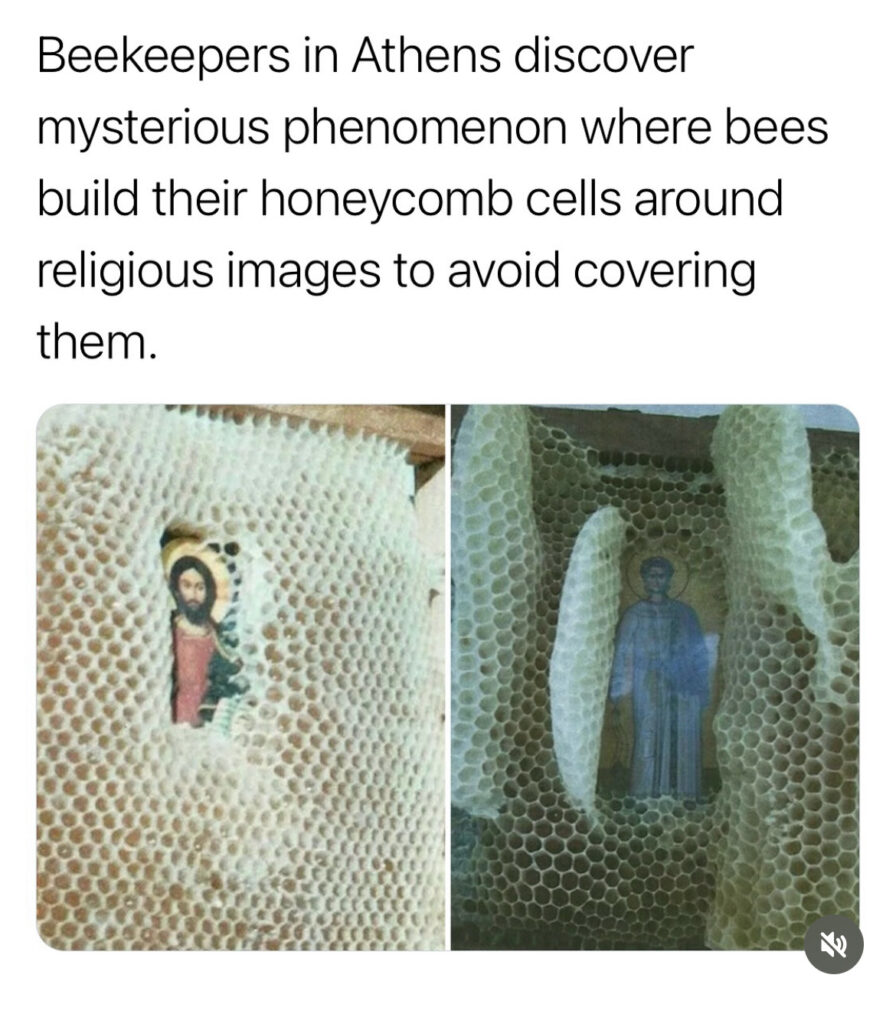
bee magic
-
The interface effect
What does this mean, that we are the gold farmers? It means that in the age of postfordist capitalism it is impossible to differentiate cleanly between play and work. It is impossible to differentiate cleanly between nonproductive leisure activity existing within the sphere of play and productive activity existing within the sphere of the workplace. Such a claim should be understood both in a general and specific sense. In general, postfordist workspaces are those that have ballooned outward into daily life to such a high degree that labor is performed via phone in the car, on email walking down the street, or at home after putting the children to bed. Crosscutting this outward expansion is an internal collapse of the workspace itself, as the “bored at work” classes invent new ways to slack off on the job, surfing the web, and otherwise circumventing the necessities of workplace always-on performance. But also in a more specific sense, postfordism is a mode of production that makes life itself the site of valorization, that is to say, it turns seemingly normal human behavior into monetizable labor.
The new consumer titans Google or Amazon are the masters in this domain. No longer simply a blogger, someone performs the necessary labor of knitting networks together. No longer simply a consumer, browsing through links on an e-commerce site, someone is offioading his or her tastes and proclivities into a data-mining database with each click and scroll. No longer simply keeping up with email correspondence, someone is presiding over the creation and maintenance of codified social relationships. Each and every day, anyone plugged into a network is performing hour after hour of unpaid micro labor.
– Alexander Galloway
read the book -
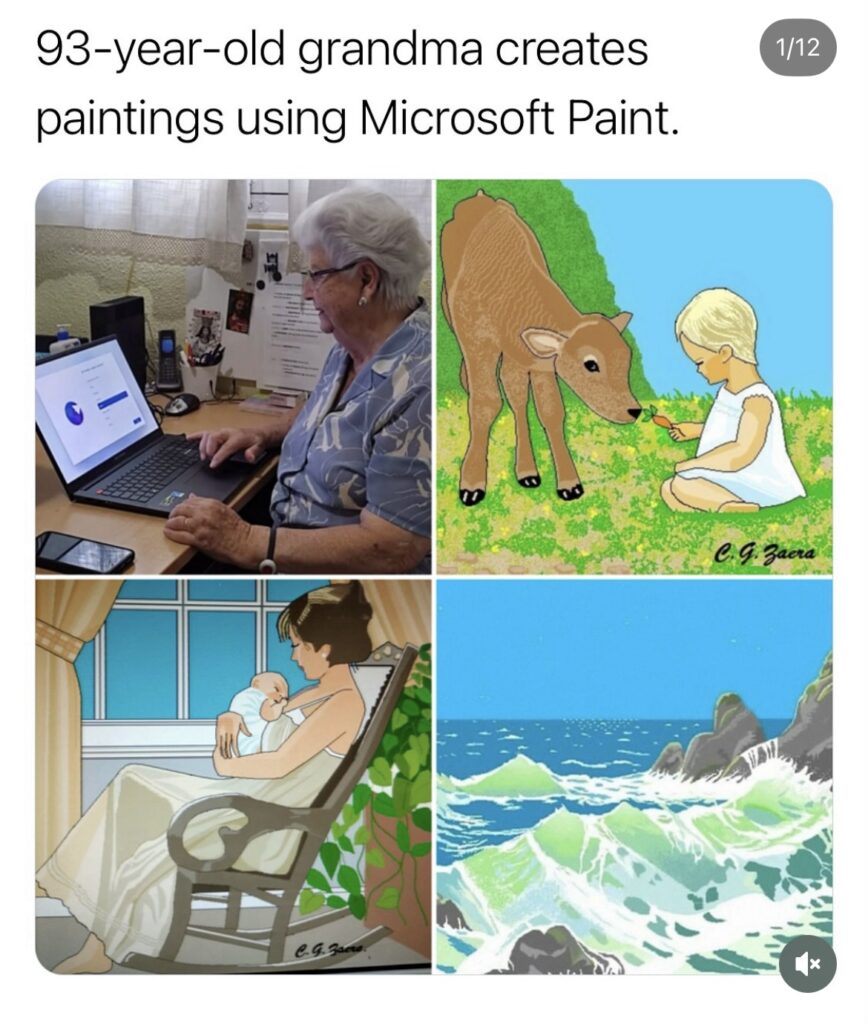
grandma paint
-
Google tree
-
index.space
read more
or follow index_space -
relic

-
Arch+ 111
“The global shakeup referred to as the “Communications revolution” has reduced the actual structure of the house to ruins. Material and immaterial cables have penetrated it, have made Swiss cheese of it: antennae through the roof, television through the walls, telephones between individual houses. We no longer dwell, but hide in ruins through which blow the blizzards of Communications. No use trying to adapt those ruins: a new architecture for people who “survive the revolution” is called for.
To begin, we must relinquish geographical for topological thinking. We can no longer think of a house that is placed somewhere geographically. Take a solar System as an example. We used to think of Earth as occupying a place within that System. Computer-generated images now demonstrate that Earth is a curve within a wire net called “the gravitational field of the sun.” We could imagine a house as a curve within the wire net called “human relations”. Within that curve, human relations become ever denser, and the house is that point where the relations are densest.
The new house should be “attractive” (in the sense in which Earth is attractive). It should attract ever new human relations. It must be in a constant process of construction. Ever new relations must be its input, and it must process them into information. That information must be transmitted to other houses. The house must become a knot within the human nerwork, a creative knot within which the sum of information at the disposal of humanity (the sum of “culture”) increases – which is to say that it must be a knot built on material and immaterial cables.”
– Vilém Flusser
read more -
bodyscan
-
the Sysadmin state
“The cybersecurity industry describes its work in terms of “cyber security architectures,” “data silos,” “software fortresses,” or “castle-and-moat security models.” These architectural references should not be taken at face value; they are employed as a discursive strategy to build trust by transferring the “aura” of architectural robustness to entities such as software or hardware solutions. This echoes the long history of fortification architecture, which has always represented a built compromise between the openness necessary for commerce and the enclosure required for rulers to secure a territory’s sovereignty. The negotiation and materialization of such compromises has been a site of constant political contestation, shaping the distribution of power and authority.”
– Florian Hoof
read more -
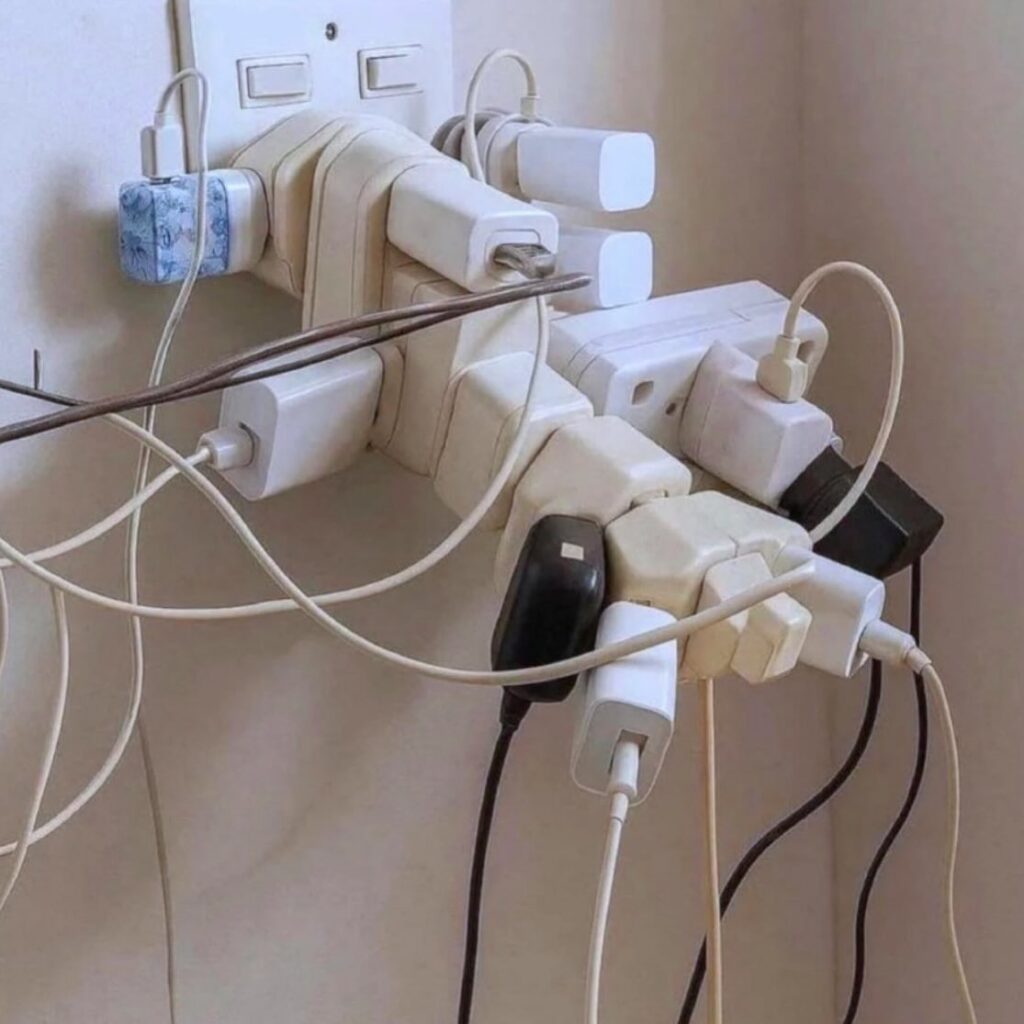
kabelsalat
-
heavenly-angels.org

read more (at your own risk) -
Björk’s TV
-
terra0
“A forest has an exactly computable productive force; the market value of the overall output of the forest can be precisely calculated. Beside its function as a source of raw material, the forest also holds the role of service contractor. It produces not only wood, but serves as a protected space within which diverse species can survive, contributing to an overall ecological balance. Furthermore, it offers space for relaxation. The terra0 project creates a scenario whereby the forest, augmented through automated processes, utilitises itself and thereby accumulates capital. A shift from valorization through third parties to a self-utilization makes it possible for the forest to procure its real exchange value, and eventually buy itself. The augmented forest is not only owner of itself, but is thus in the position to buy more ground and therefore to expand.”
– Paul Seidler + Paul Kolling
read more -
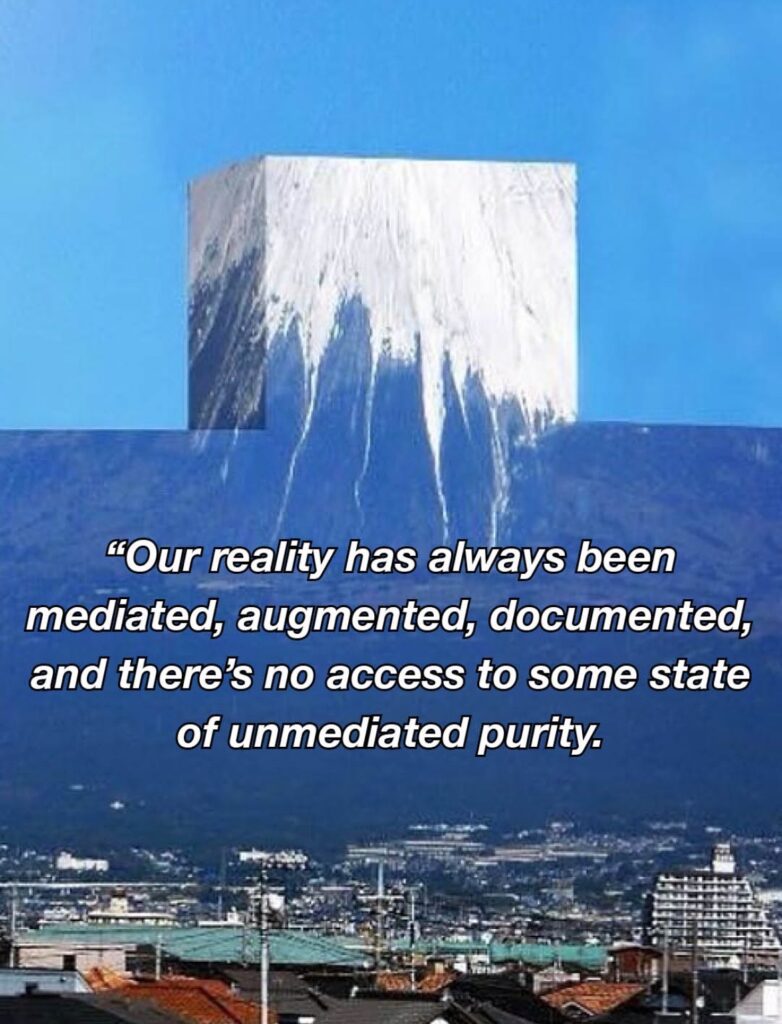
unmediated purity
-
extrastatecraft
“For each technology in infrastructure space, to distinguish between what the organization is saying and what it is doing—the pretty landscape versus the fluid dynamics of the river—is to read the difference between a declared intent and an underlying disposition. The activities of a technology may be difficult to see even though, given the ubiquity of infrastructure space, they are hidden in plain sight. Examining each one, each active form—like each dimple or ripple on the water or each bit of code in the software—makes it more palpable. Detecting and developing the active forms that shape disposition is an essential skill of the urbanist in infrastructure space”
– Keller Easterling
read the book -
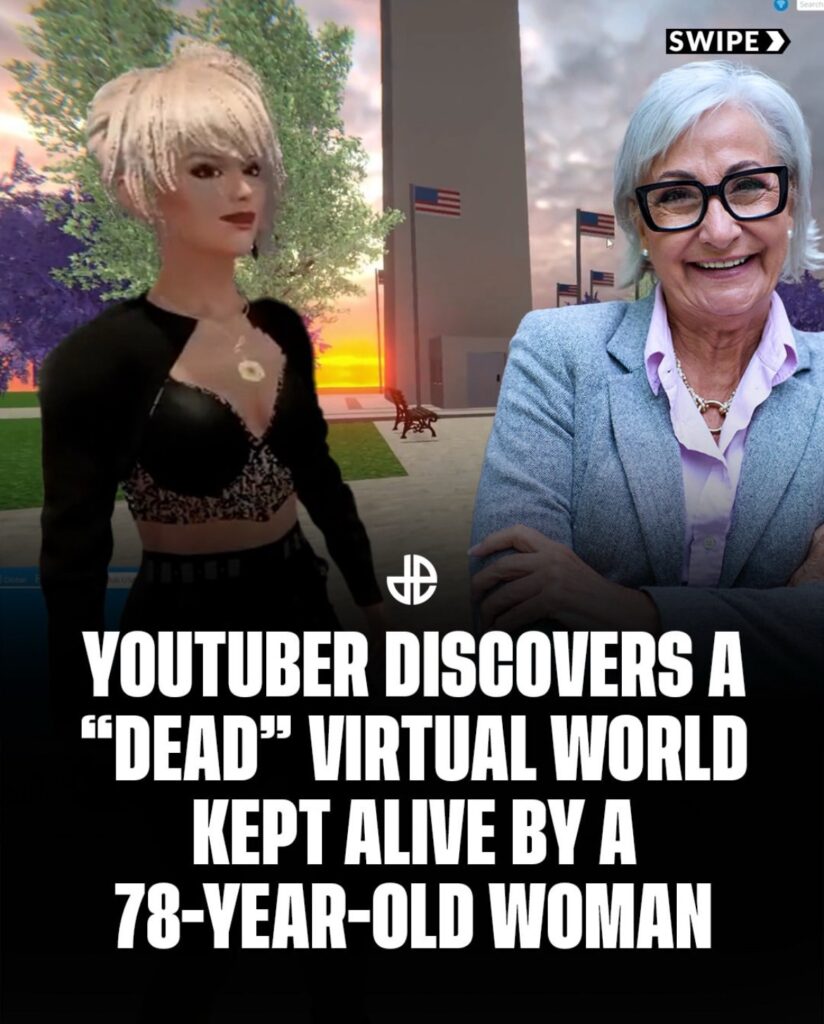
Thriving
-
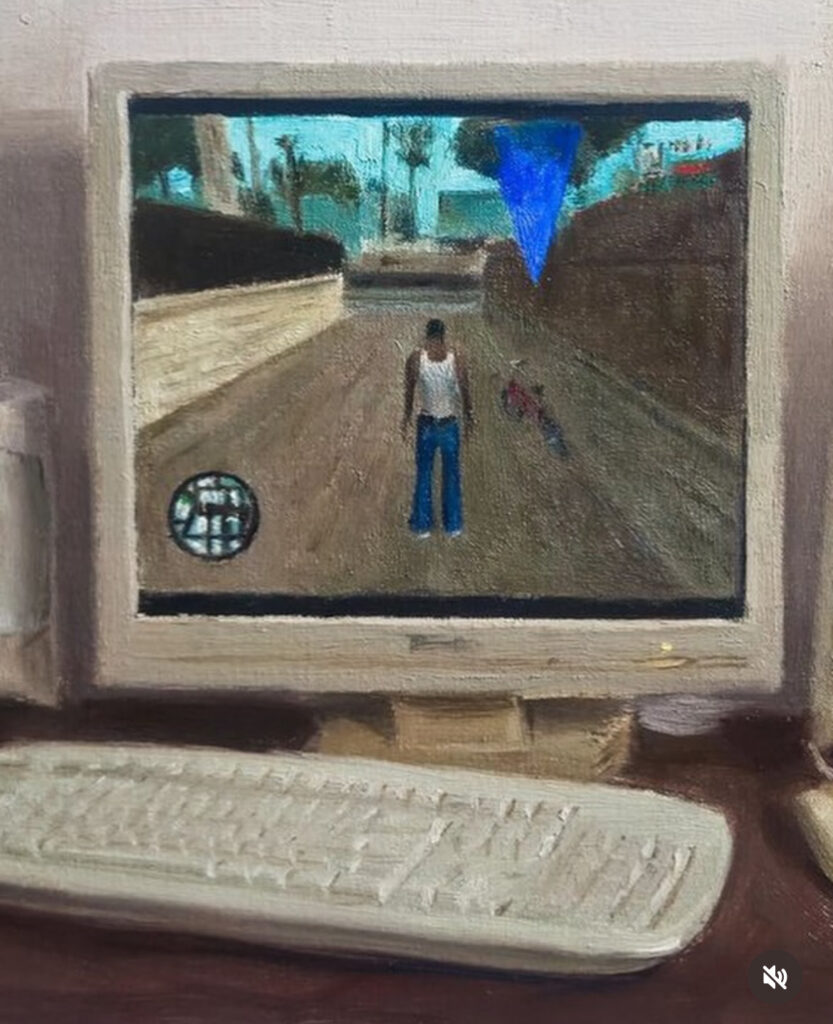
Grove Street Nostalgia 2
-
Fails

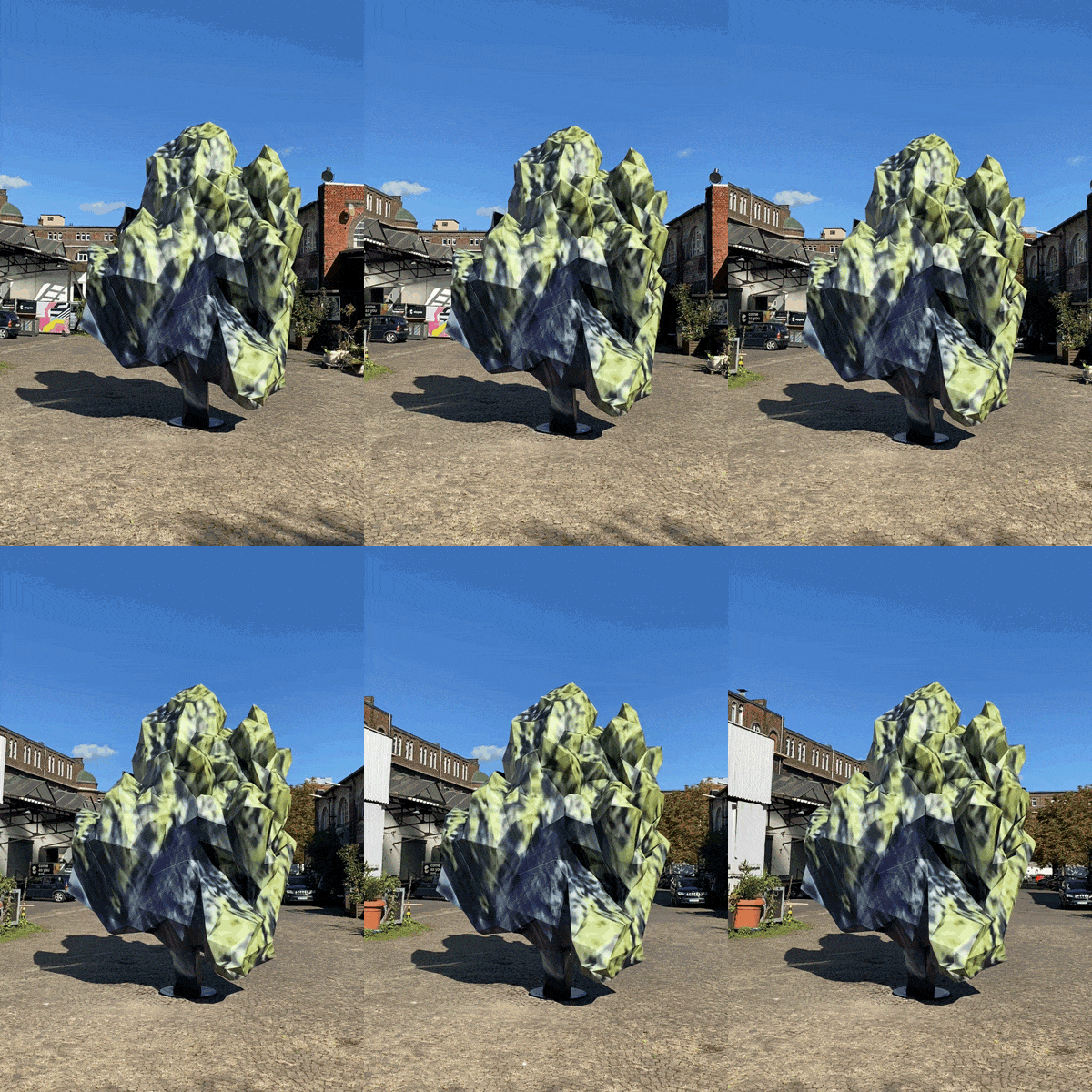
“fails is a series of sculptures that cheerfully reveals the fragility, disintegration, and feeling of superficiality that pervades our lived reality. Based on the simulation models of 3D scans, a digital phenomenon is translated into physical space. Like the virtual scan—freed from the necessity of gravity—the fragmented space floats across the exhibition space.Materials are reduced to their surfaces: sanded, gutted, yet still real. That which usually determines their function recedes; what remains visible is a filigree layer that, in an unsettling way, exposes both the material and the fragility of our embodied environment. Glitches arise where materials actually meet, but now merge into one another and boundaries become unclear.”
– Tobias John
-
Latent Space Astronauts
-
Astrology is fake

-
Noema Magazine
-
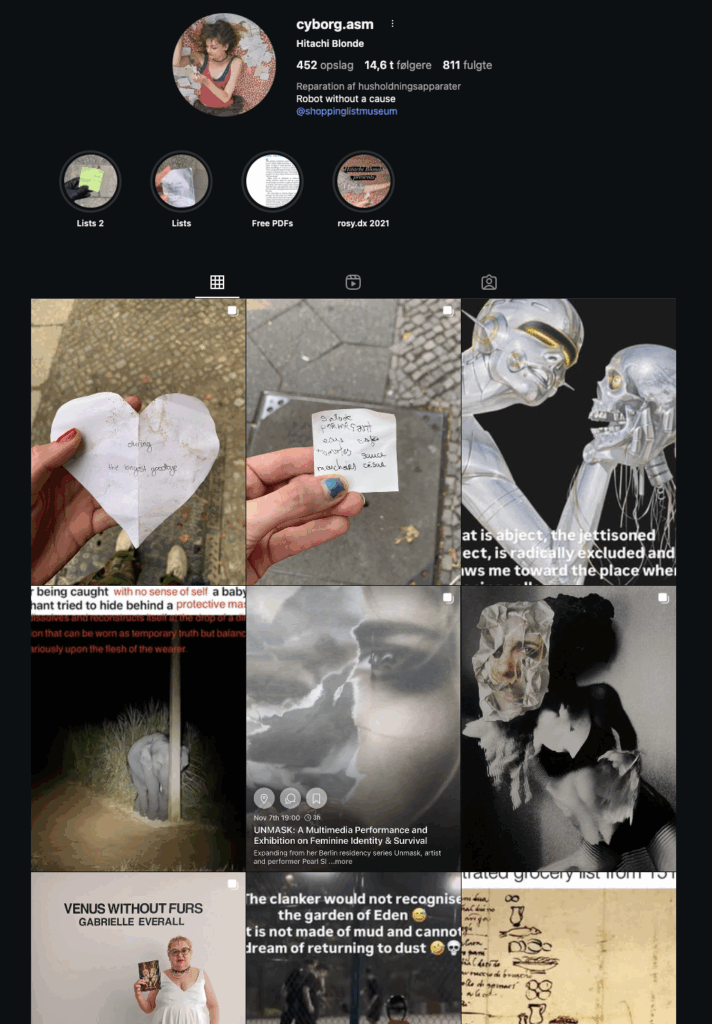
cyborg.asm
-
Darf Furry Forest
-
Cyberwitch Manifesto
Let’s say the words.
Let’s make the gestures.
Let’s manipulate the objects.
Let’s summon archetypal relics.
Let’s call for the emergence of egregores.
Let’s seek for a fleeting energetic symbiosis.
Let’s practice this art of changing consciousness at will.
Let’s be cyberwitches.
– Lucile Haute
read the cyberwitch manifesto -
Post office
-
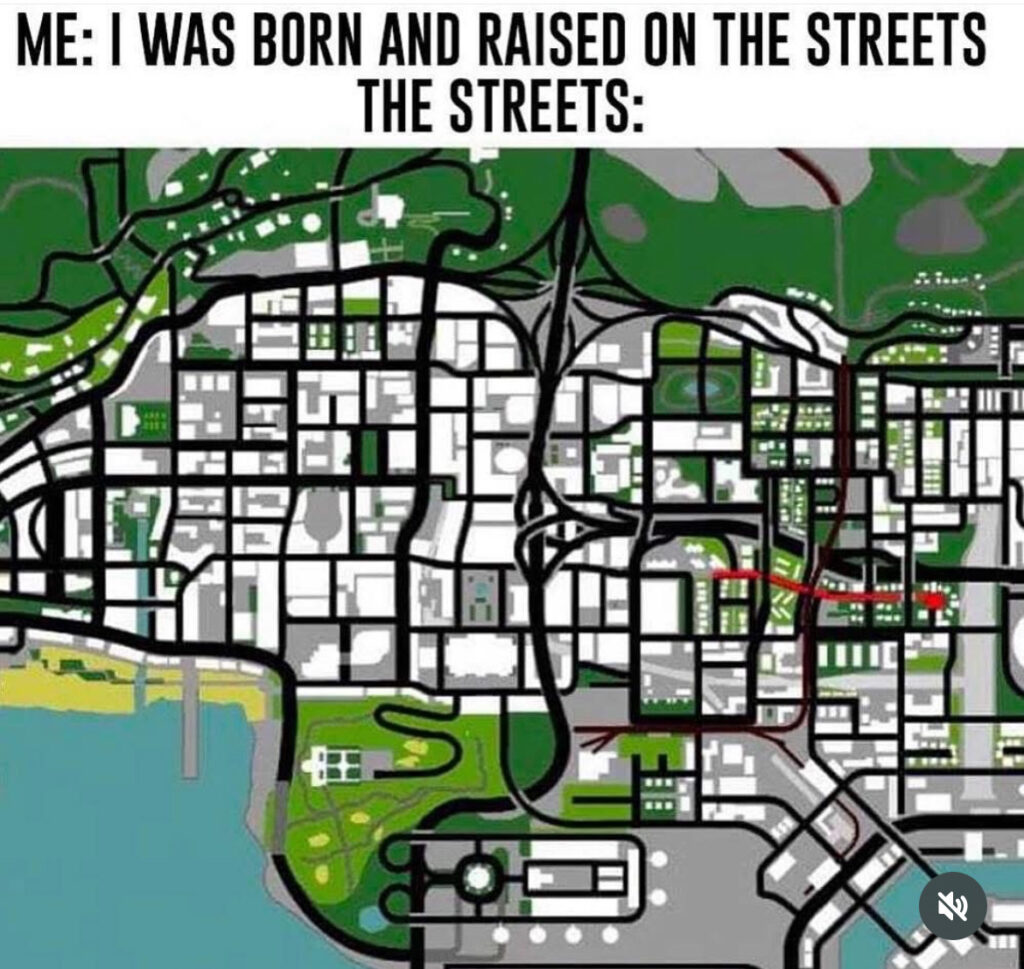
grove street nostalgia
-
The Swarm
“Waves of outrage mobilize and bundle attention very efficiently. However, their fluidity and volatility make them unsuited to shaping public discourse or public space. They are too uncontrollable, incalculable, inconstant, ephemeral, and amorphous for that. They well up abruptly—and they dissipate just as soon. They are like smart mobs. They lack the stability, constancy, and continuity that are indispensable for civil exchange. Accordingly, they defy integration into a stable discursive context. Waves of outrage often occur in response to events of only meager social or political relevance.
Outrage society is scandal society. It lacks bearing—reserve and posture. The fractiousness, hysteria, and intractability that characterize waves of outrage do not admit tactful or matter-of-fact communication; they bar dialogue and discourse. Yet bearing, a measured stance, is what constitutes the civil sphere. By the same token, distance is necessary for this sphere to emerge. More still, waves of outrage evince little identification with the community as it stands. The outraged do not form a stable we who are displaying concern for society as a whole. Enraged citizens, even though they are citizens, do not demonstrate concern for the whole of the social body so much as for themselves. For this reason, outrage quickly dissipates.”
– Byung Chul Han
read the book -
The worst server on the internet
-
Communicology
“Imagination is the capacity to project supposedly real relations upon a surface (make images) and to reproject supposedly real relations from a surface (decipher images). Conception is the capacity to explain images by unrolling them into lines (describe them) and to reconstruct images from texts (read texts). Technical imagination is the capacity to project texts upon a surface (make images of concepts) and to reconstruct the texts from those images (see through the technical images). We are programmed for imagination and conception, but not for technical imagination.”
– Vilem Flusser
read the book -
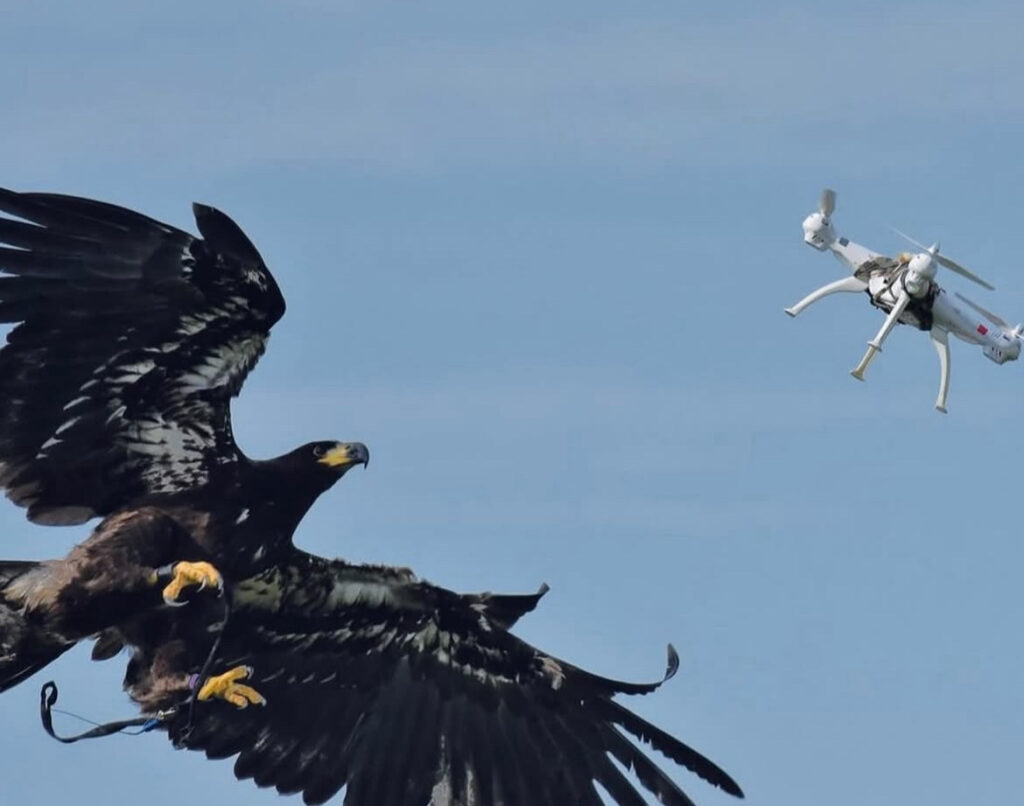
Drone Hunting
-
The extreme self
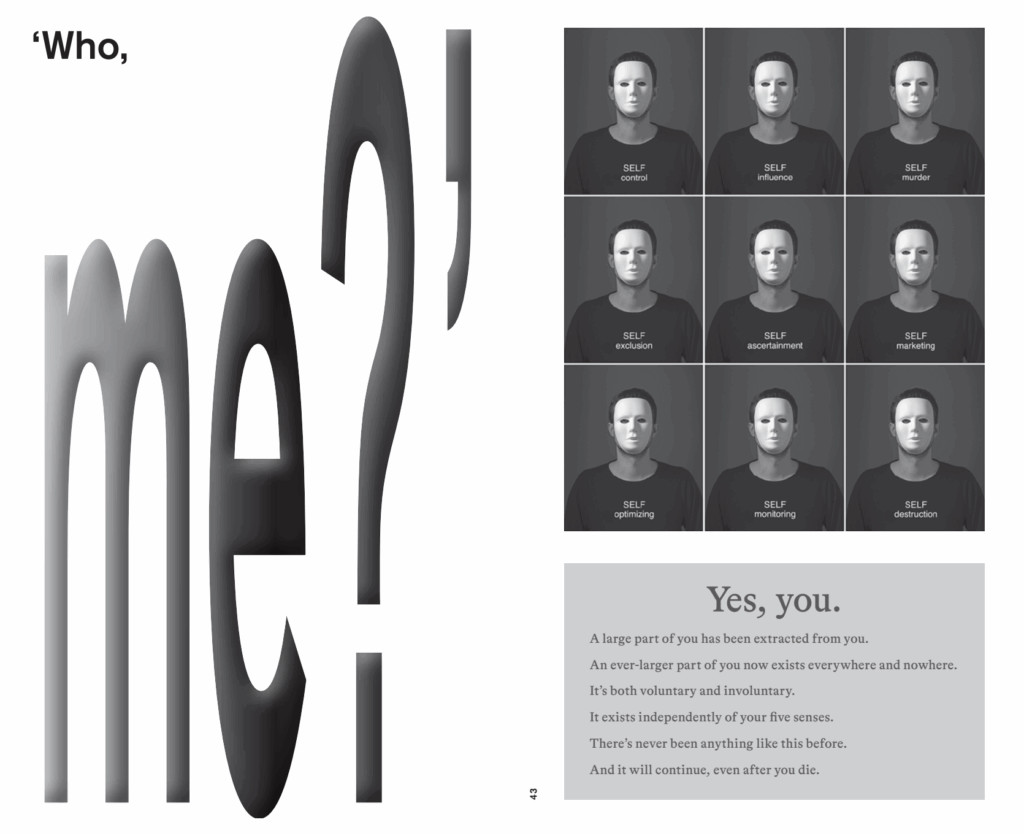
– Shumon Basar Douglas Coupland Hans Ulrich Obrist
read the book -
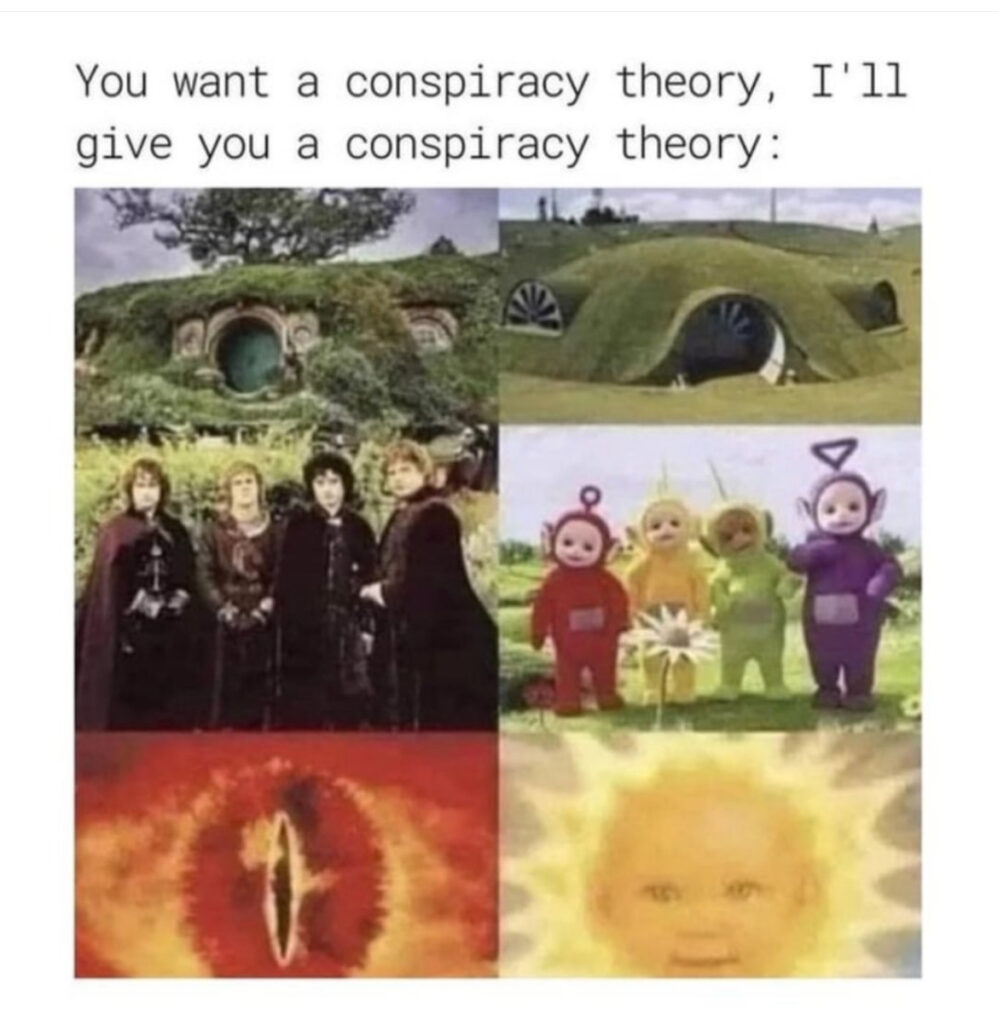
Conspiracy
-
Torment Nexus
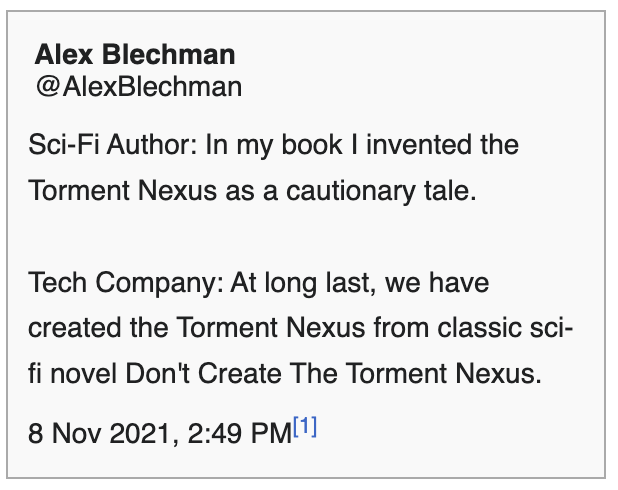
The term [Torment Nexus] was coined in a 2021 Tweet by The Onion staff writer Alex Blechman, shortly following Facebook‘s announcement that it would be rebranding to Meta Platforms as part of a shift in the company’s focus towards developing a metaverse.[2]
Dais Johnston of Inverse has defined the Torment Nexus as “shorthand for something that backfired in fiction being unironically replicated in reality.”[3] Reviewing the 2023 CES trade show, Katie Wickens of PC Gamer defined the Torment Nexus as “a concept that encompasses our growing concern that science fiction will continue to become science fact across the consumer market, with the phobias wrought by technological speculation turning palpable in the hands of money-hungry corporations.”[4] In September 2025, MOSF Journal of Science Fiction editor Gabriel Burrow wrote that the term had become “a common joke within science fiction circles… The joke, of course, is that tech executives fail to engage with the critical aspect of science fiction—even when it’s staring them in the face.”[5]
– Wikipedia -
Spiraling (NM)
“Are we entering a neo-oral age? For centuries, linear, text-based media has organized human communication, creating a shared reality, a shared sense of linear time. But as political Scientist Kevin Munger discusses on this ep of NM Talkcore, that ontological structure is rapidly coming undone.”
read more Kevin Munger
read more NEW MODELS -
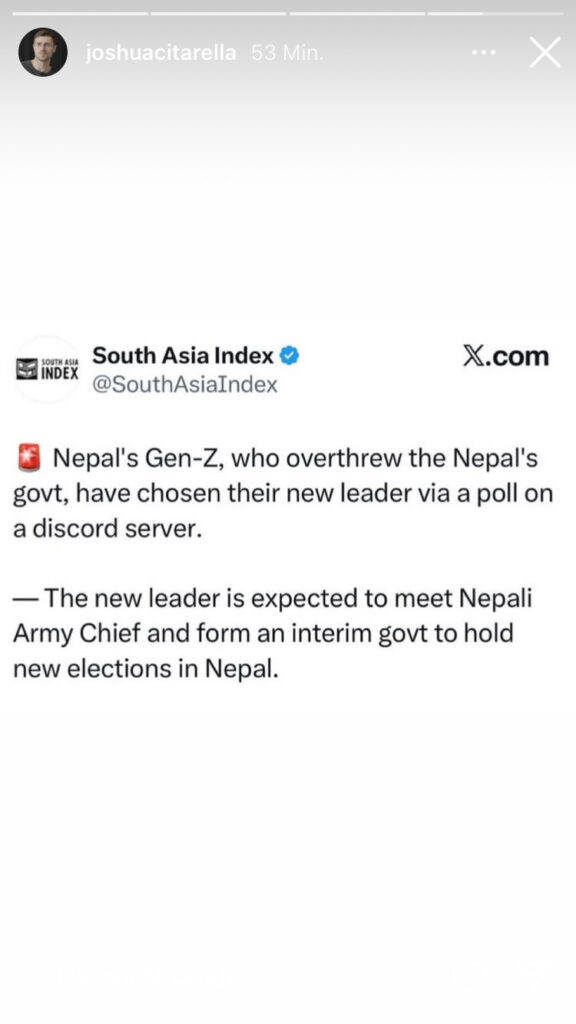
Discord Democracy
-
The internet does not exist
“The social no longer manifests itself primarily as a class, movement, or mob. Neither does it institutionalize itself anymore, as happened during the postwar decades of the welfare state. And even the postmodern phase of disintegration and decay seems over. Nowadays, the social manifests itself as a network. Networked practices emerge outside the walls of twentieth-century institutions, leading to a “corrosion of conformity.” The network is the actual shape of the social. What counts – for instance, in politics and business – are the “social facts” as they present themselves through network analysis and its corresponding data visualizations“
– Gert Lovink in The Social in Social Media
read the book -
anthr0shit
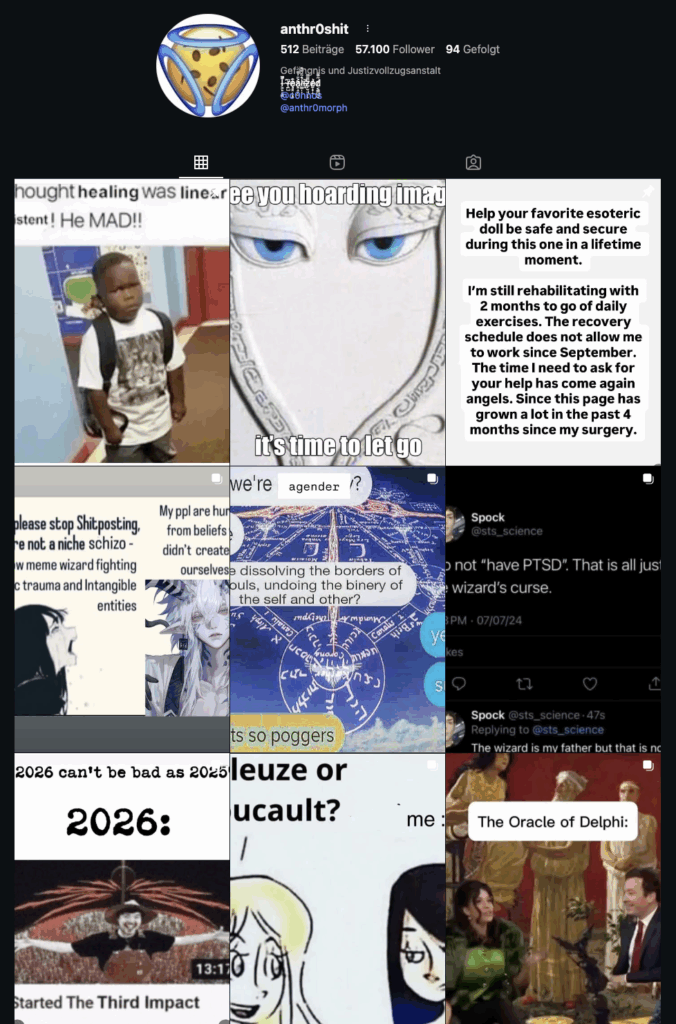
follow anthr0shit
-
Contraptions (blog)
“As the name of the newsletter and the samples suggest, the general idea is to explore our world as a contraption-of-contraptions, with contraptioney mental models, and a contraptioneer sensibility. The sensibility is that of half-assed engineering, but the scope is universal. I talk about contraptions of all sorts, not just technological ones. So you’ll find discussions of political, economic, and philosophical contraptions.”
for example:
A Camera, Not an Engine
Cozytech
Principles for the Permaweird
– Venkatesh Rao
read more on substack -
Near Me


-
Apocalypse-Proof

“The emergence of digital technologies from military research and development is well documented, so perhaps it’s a mark of continuity that security operations today are contingent on control of online traffic. The miles of cable at 33 Thomas Street undergird the digital placelessness of the contemporary security state. Such automation doesn’t inevitably make the state more effective, of course, as failures like 9/11 and Edward Snowden’s leaks make clear. But it does make for reduced accountability.
The market for AI-enabled weapons is predicted to reach $30 billion by the end of the decade. These weapons will at first be deployed in theaters of combat far from the metropole, deep in the ocean and high in the sky. The algorithms that give them agency will bounce from server farm to server farm, evolving as they go; they will be poor targets for democratic upswells of pro-human sentiment.”
– Zach Mortice
read more -
Asmr tarot
– White Feather Tarot